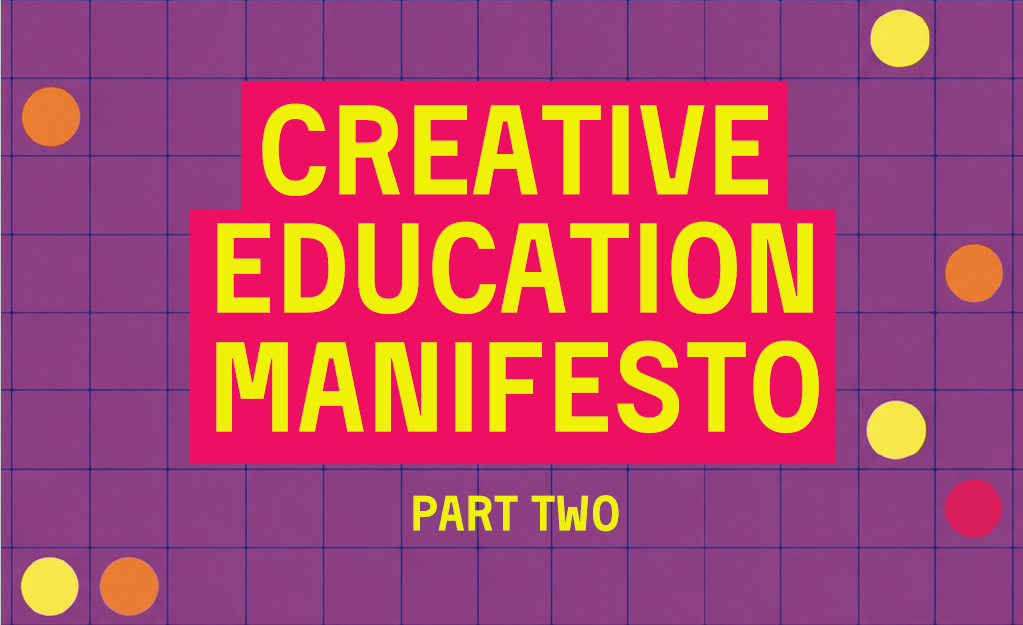
Today (Monday 28 September), at the Labour Party Conference, the Creative Education Coalition is publishing a new Creative Education Manifesto, calling on the government to place creative education at the heart of its plans for growth, skills and regional regeneration.
The Creative Education Manifesto Part Two: Building Britain’s Creative Future sets out seven principles designed to ensure creative education is recognised as an essential driver of economic growth, social wellbeing and the UK’s global influence.
The manifesto argues that the government’s ambitions to drive growth across every region of the country will depend on a strong creative education pipeline, from schools and colleges through to universities, apprenticeships and the workplace.
The coalition is calling on ministers to guarantee access to high-quality creative education for every child and young person, embed creativity across curriculum and skills reform, and invest in local creative ecosystems that support growth, regeneration and thriving communities.
Vanessa Wilson, CEO of University Alliance, said:
“Britain cannot have a thriving creative economy without a thriving creative education system. The talent behind our world-leading creative industries is developed through a pipeline of opportunities stretching from schools and colleges to universities and the workplace.
As ministers gather at Labour Party Conference to discuss how to deliver growth across the country, creative education must be part of the solution. If the government wants every town and city to benefit from the opportunities created by the creative industries, it must properly invest in the education and skills pipeline that makes that success possible.”
ENDS
Notes to editors
Media contact
For press enquiries call Elizabeth Sommerville, Director of Communications on 07539 154067.
About University Alliance
University Alliance (UA) represents 20 of the UK’s leading professional and technical universities. Our members specialise in working with industry and employers. Their teaching is hands-on, and designed to prepare students for careers. Their knowledge and research drive industry to innovate, thrive and meet challenges.
About the Creative Education Coalition
The Creative Education Coalition (CEC) is a group of organisation from the higher education and creative sectors, who are deeply concerned about the future of the creative talent pipeline, and the lack of engagement in developing creative skills in the school system.
We came together in 2022 to collaborate on advocacy work around creative education – releasing our Creative Education Manifesto in 2023. Since then, we have been growing and adapting, bringing us to the establishment of our Compact in 2024.
In 2026, recognising the need for renewed policy focus in light of the new government, the CEC published part two of its manifesto, calling on government to properly value creative education as the foundation of the UK’s future creative and economic success.
The Creative Education Coalition membership:
- University College London including The Slade
The manifesto calls on the government to:
- Guarantee every child and young person access to high-quality creative education, specialist teaching and enrichment opportunities regardless of background or postcode.
- Place creativity at the heart of curriculum reform, skills policy and industrial strategy.
- Create a connected national creative talent pipeline linking schools, colleges, universities, apprenticeships and industry.
- Invest in place-based creative ecosystems that support growth, regeneration and community wellbeing.
- Reform how government measures the contribution of creative skills, education and employment to the economy.
- Recognise creativity as a key contributor to addressing societal challenges, including AI adoption, sustainability and health.
- Ensure the UK remains open to international talent, ideas and cultural exchange.